Australia
 Brazil
 China
China Croatia
 Europe
 France
 Germany
 Italy
Italy Japan
Japan Latin America
 Netherlands
 Spain
Spain Turkey


Every VALO™ curing light began with a dentist having a problem.
Curing lights, historically, have been fragile, not taking kindly to the common mishaps present around every corner of a dental office. That’s why the Ultradent R&D team chose to build the durable VALO lights from aerospace-grade aluminum. To test their durability, Ultradent sent a VALO light to space and dropped it back to earth in 2019. The light landed in Utah mountains where it remained for 126 days before being found, and it still worked. VALO curing lights are built with durability in mind.
Similarly, the low-profile head, the broad-spectrum LED, and larger lenses were all designed because a dentist had a problem.
But not all dentists have the same problem. "A pediatric dentist working in a smaller mouth isn't always after the same lens as a clinician placing a large posterior restoration,” says Ultradent Senior Vice President of Research and Development Neil Jessop. “After we released the VALO X curing light, we heard dentists say ‘You’re not going to give me those old lights that I loved? They were my thing.’”
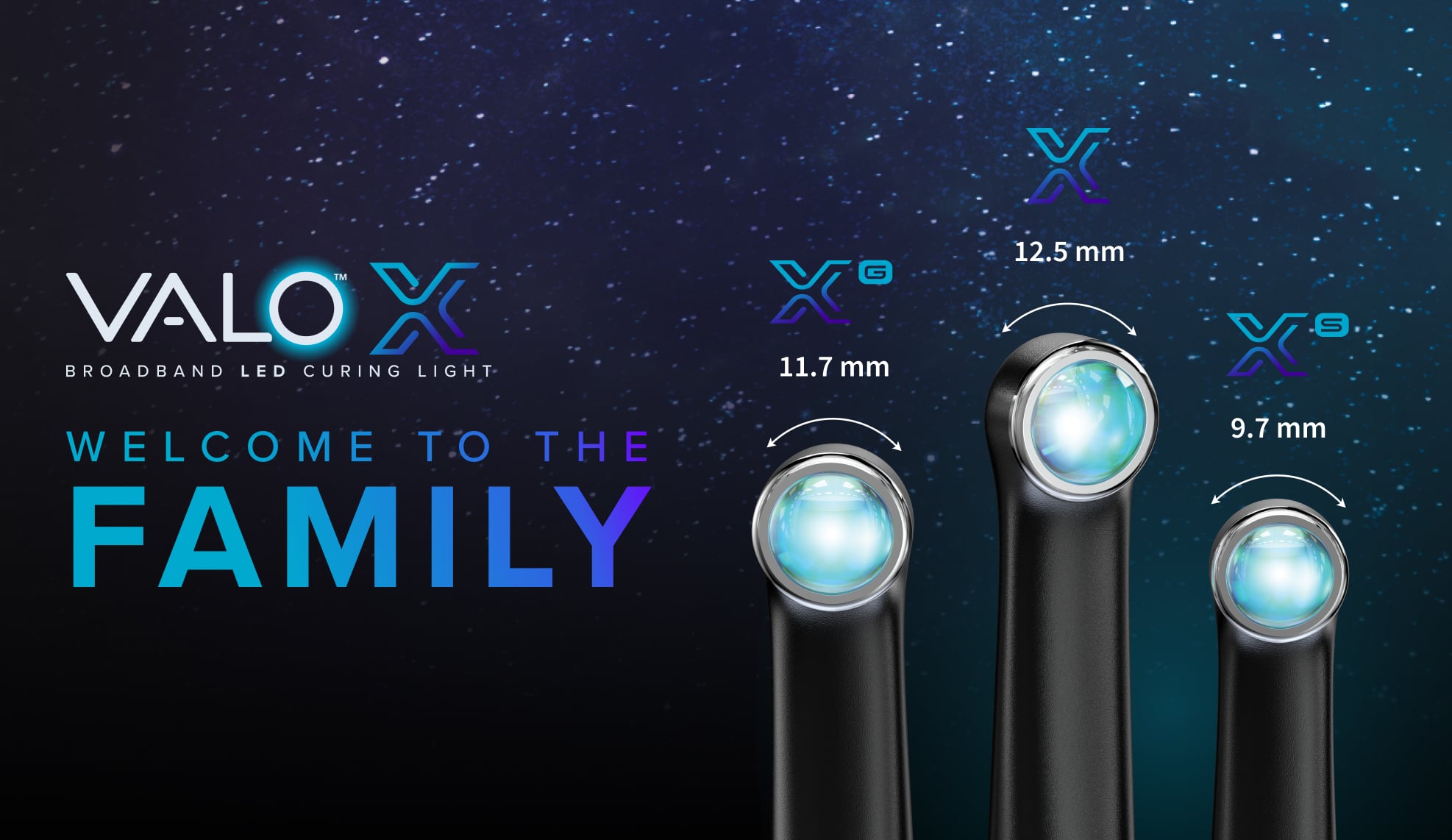
The VALO XS and VALO XG lights merge those legacy lens sizes with the modern upgrades of the VALO X light.
Multiple Decades, One Idea
Back in the late 1990s, bonding studies were exposing the limits of the quartz-halogen lights on the market at the time. “They were big and bulky, which made it difficult to access restorations in the posterior of the mouth, and they were also incredibly fragile and not completely dependable,” Jessop says. Ultradent’s answer was the UltraLume™ light, among the first LED curing lights available to dentists.
What followed is, by now, familiar to longtime VALO light users:
- The VALO Corded curing light (2009)
- The VALO Cordless curing light (2011)
- The colorful VALO™ Colors line of curing lights (2013)
- The larger-lens VALO™ Grand curing light (2016), later released in a full line of colors (2019)
- The VALO™ X curing light (2022) family that refined the platform with a custom LED chip, one-button activation, and seven inspiring colors
“There’s been an evolution,” Jessop says. “What we were doing in 2009 wasn’t the epitome, but it still set the stage, with that 9.7 mm lens as an exceptional lens.” The lens grew from there, 11.7 mm on the VALO Grand light and 12.5 mm on the VALO X light, “because our goal was a bigger blended footprint,” Jessop adds.
Why Two New Lights, and Why Now?
Different clinicians reach for different lens sizes, and the choice is often about fit, both with the anatomy in front of them and the rhythm of how they practice. And sometimes, a smaller lens is what the clinician wants for those situations.
“The VALO XS and VALO XG lights are catering to that need and still raise the bar for everyone,” says Jessop. “Each size is engineered to deliver the output its lens calls for. There’s all the power you want in the 9.7, all the power you want in the 11.7. We brought that VALO X platform functionality, like the batteries and the sleeker handles, into those two previous generations of heads.”
The VALO XS and VALO XG lights match power output whether a clinician cures for five seconds or ten. “We want the same total energy going into the tooth in Xtra Power in five seconds as would be delivered in 10 seconds,” Jessop says.
VALO XG Curing Light
The VALO XG curing light pairs an 11.7 mm lens with the VALO X light platform. The light offers Standard Power and Xtra Power modes, a built-in black light diagnostic aid mode, and compatibility with multiple accessory lenses, including the ProxiCure™ Ball lens, PointCure™ lens, TransLume™ lens, Interproximal lens, and White Light lens.
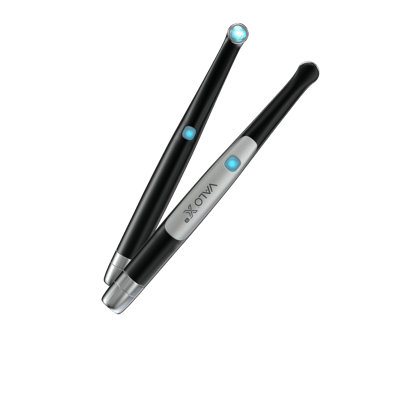 The VALO XG Curing light
For a clinician working through a long restorative day, that broader, more uniform coverage can help reduce the number of cures per restoration and support more confident, margin-to-margin polymerization.
VALO XS Curing Light
The VALO XS curing light keeps the 9.7 mm lens that defined the original VALO light, a size that fits comfortably in smaller mouths and over individual brackets. It features three curing modes: Standard Power, Xtra Power, and Ortho Quadrant mode, which pulses three seconds on and two seconds off. Like its larger sibling, it includes the black light diagnostic aid mode and works with the accessory lens system.
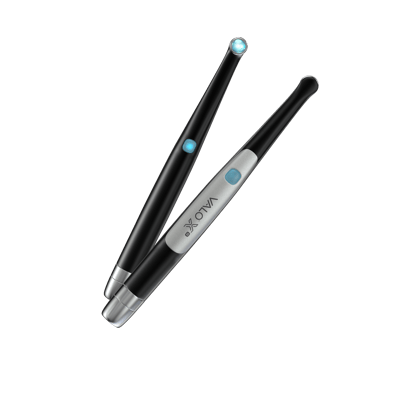 The VALO XS Curing Light
What Stays the Same
Beneath the tailoring, the Ultradent R&D team guarded features longtime users trust most. “The pieces that are sacred are the lens size and the beam uniformity,” Jessop says. “Those trust elements of beam size and durability had to continue forward, and they have.”
From there, the work was refinement. “VALO lights were so good already, but honestly, there’s always something you can do a little better,” Jessop says. The sleek unibody design allows for better seals and a surface clinicians can wipe down and trust. These elements were built on hard-learned lessons. On earlier lights, a determined user could occasionally work an activation button loose; the newer design seats that flange beneath the panel so the lights “will just be more durable,” Jessop says.
The Number that Matters: Power
If there’s one idea Jessop hopes clinicians take from this generation of curing lights, it’s a shift in how the profession talks about curing. For years, the conversation has centered on irradiance. “Unfortunately, we’ve actually been stuck to this word called irradiance, which is actually a brightness term,” he says.
Many meters sample only a small spot at the center of the beam. “I don’t care about that middle point, because that could be quite low total power that got delivered,” he says. “I want to be talking about total power that gets delivered, and that’s usually described in joules. How many joules did a tooth receive?”
“VALO X, VALO XS, and VALO XG lights all are moving toward a terminology where we are saying how many joules they deliver in a cycle, whether it’s the five-second cycle or the 10,” Jessop says. “And the VALO X family of lights deliver the same joules in five seconds as 10 seconds.”
His caution to clinicians is to look past the headline of irradiance and brightness. “Just because the brightness number looks similar doesn’t mean the power that came out of it, the total big wash of energy, was the same,” he says. “It’s just a paradigm shift in the way we talk. We’ve had too many years of hearing irradiance numbers. We have to move the needle toward discussing power and joules.”
Developed for How You Practice
For all that’s new, the throughline of the VALO XS and VALO XG lights is the same one that has run through VALO lights from the beginning.
“We didn’t get here for free,” Jessop says. “A lot of people worked so hard to get to this point, and I always feel a sense of urgency to stay ahead of the pack.” He credits much of that instinct to Ultradent founder Dr. Dan Fischer, a dentist who has long pushed the team to design with an eye on solving specific problems.
The VALO XS and VALO XG lights are an effort to build for the way clinicians actually practice, not the way a catalog assumes they do. “I think they’re amazing lights,” Jessop says. “I love that we get to move into such a quality space with all of these models.”